LeafAI Case Study
LeafAI is a web interface that helps users predict how long leafy vegetables (especially waterleaf) will stay fresh under different storage conditions such as ambient, refrigerated, or frozen using image uploads and visual insights.
Role
UX research, User flows & wireframes, UI design, UX copy,Prototyping
Duration
3 Weeks
Tools Used
Figma, Google Doc, Sketch
Year
2025
Problem Statement
People often struggle to know the best way to store leafy vegetables, which leads to quick spoilage and food waste. Existing solutions are either too technical or not visually clear enough for everyday users.
Project Goals
The goal was to:
Make freshness prediction easy and visual
Help users compare storage options quickly
Present insights in a friendly, non-technical way
Create a calm, nature-inspired experience
My Role: Using the developer-created PRD as a foundation, I was responsible for:
Structuring the user flow
Designing wireframes and UI
Writing clear, conversational UX copy
Creating a visual system that blends nature and futurism
Designing interactive states and animations
Key Design Decisions
Used a chat-style interface to make predictions feel approachable
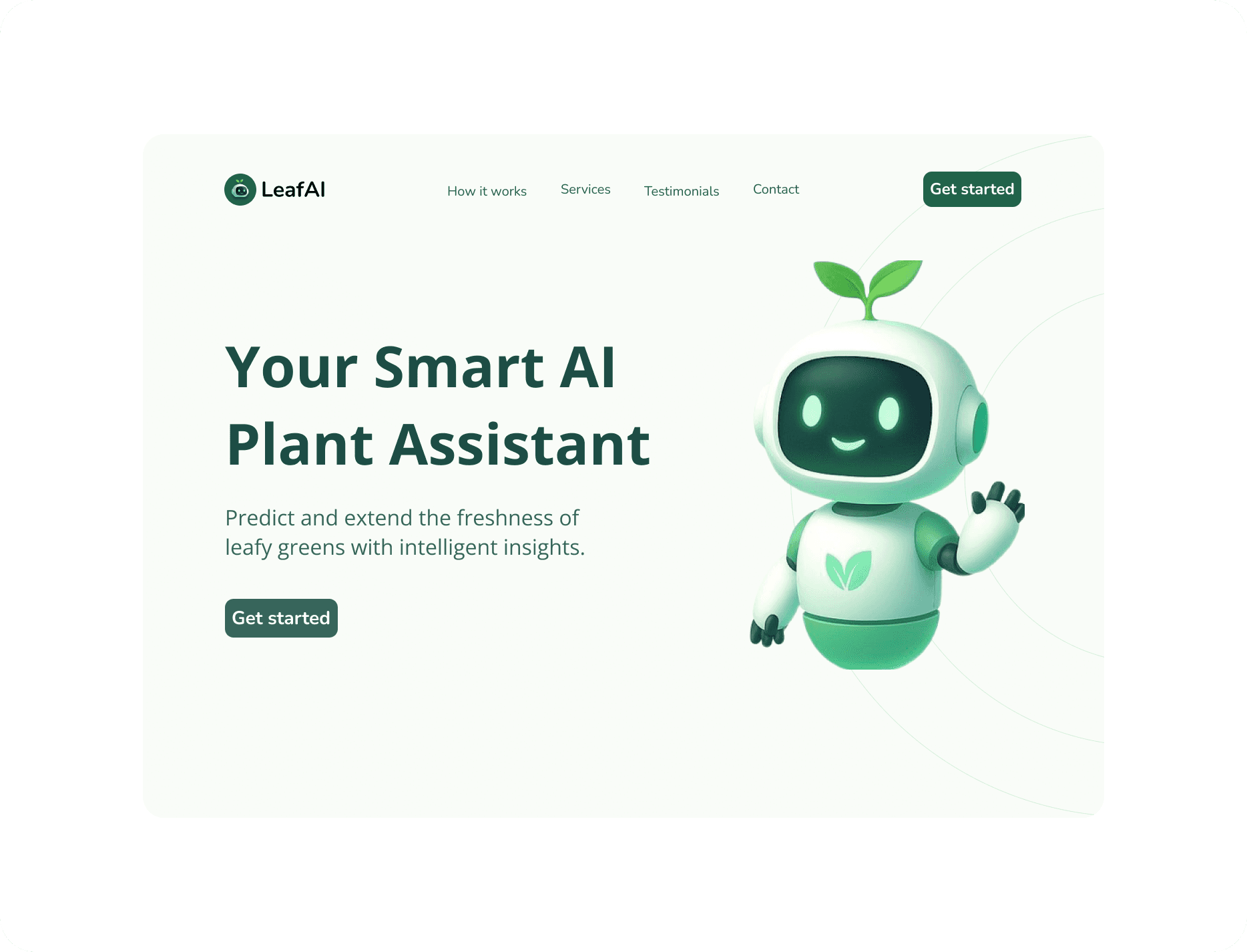
Introduced Verdea, a friendly assistant, to guide users through results
Prioritized visual charts over long explanations to reduce cognitive load
Designed a restart flow so users can easily analyze another plant
Final Solution: LeafAI consists of two main screens:
Landing Page
Introduces Verdea with an auto-typing message and a clear “Get Started” action that opens the image upload flow.
Analysis Page
Displays uploaded images alongside shelf-life predictions, recommended storage options, and simple charts showing feature importance and freshness timelines.
Outcome
Created a clear and intuitive interface for understanding plant freshness
Simplified complex data into friendly, visual insights
Designed a scalable foundation for future features and vegetable types
What I Learned
This project strengthened my ability to turn technical requirements into a calm, human-centered experience and reinforced the importance of visual storytelling when presenting complex data.